On-camera drills, message discipline, and calm under pressure
Media Training That Prepares You for the Real Interview
Media training for executives and spokespeople: TV, print, podcast and hostile interview drills that build message discipline. Book a call.
Media training is the work you do before a reporter calls, so that the interview you give is the one you meant to give. At 360 Narrative we run sessions for founders, executives, physicians, attorneys, creators and anyone who will speak for a brand, and we build each one around the interviews that person is actually likely to face.
Most people who struggle on camera are not bad speakers. They simply have not practiced the specific, slightly unnatural skill of answering a question while carrying a message. That skill can be learned in a day and sharpened over a few sessions, and it is the difference between a quote that helps you and a quote that follows you around.
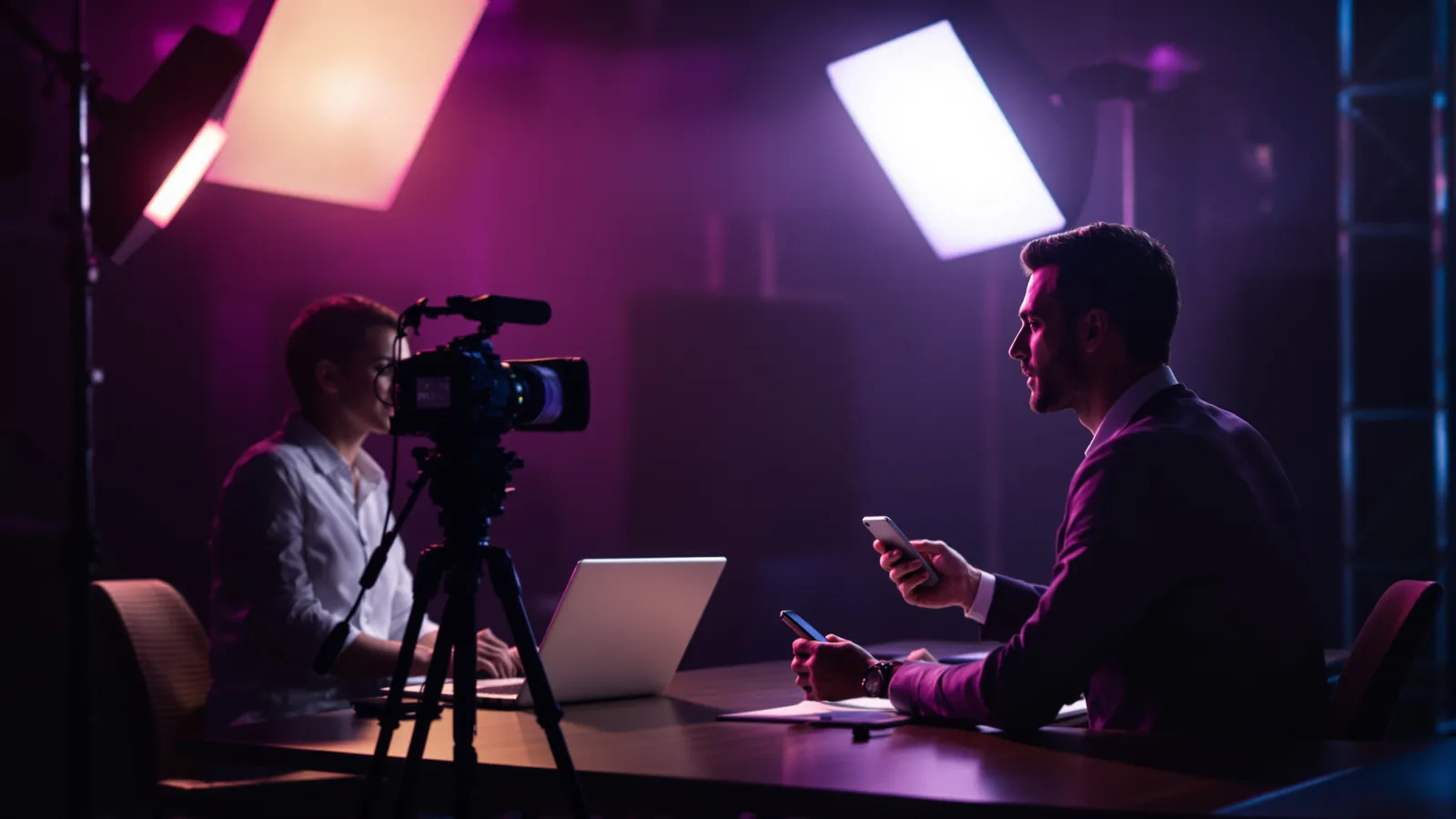
Media training is structured practice for interviews. A coach helps you settle on two or three core messages, then runs realistic mock interviews for TV, print, radio and podcasts, including hostile ones, records them, and reviews the playback with you so you learn to answer briefly, stay on message and recover from bad questions.
What Media Training Actually Covers
People often picture a single afternoon of someone yelling questions at a nervous CEO. Good media training is calmer and more useful than that. It covers four things, in roughly this order.
- How reporters work. What a print reporter needs for a story, why a TV producer pre-interviews you, what “on background” means, and why deadlines shape everything.
- Your messages. Two or three plain statements you want in any story about you, each backed by a proof point, an example or a number you can stand behind.
- Delivery. Short answers, clean openings, eye line, pace, posture, and how you sound on a phone line versus a studio microphone.
- Pressure. Hostile questions, false premises, silence, interruptions and the off-topic question that is really the whole story.
We spend the most time on the last two, because that is where people actually lose interviews.
The first two still matter. A spokesperson who understands that a reporter may be filing three stories that afternoon stops taking short calls personally and starts making the reporter’s job easier, which is the fastest way to be called again. A spokesperson who knows the difference between “off the record” and “on background” stops assuming that either one is a safe place to vent. We would rather you treat every conversation with a journalist as quotable, and we explain why with real examples of how a casual aside becomes a headline.
Interview Formats and How Each One Is Different
A ninety-second live TV hit and a forty-minute podcast conversation reward completely different habits. Part of media training is learning which habit to switch on.
| Format | What it rewards | Common mistake |
|---|---|---|
| Live broadcast | One clear point stated in the first answer, short sentences, steady eye line | Warming up slowly and running out of time before the point arrives |
| Taped TV segment | Self-contained answers that survive editing | Answers that only make sense next to the question |
| Print and online | Precise facts, context, a quotable line | Thinking aloud and seeing the loosest sentence in print |
| Podcast | Stories, warmth, real detail over a long conversation | Forgetting the recorder is on during the friendly chat |
| Radio and phone | Voice energy, vivid language, no reliance on visuals | Flat delivery and long pauses that sound like dead air |
We rehearse the formats on your calendar first. If a broadcast booking is coming through our speaking and booking work, that segment gets drilled before anything else.
Format also changes what you wear, where you look and how you sit. A remote studio link means looking into a small lens rather than at the face on the monitor. A seated panel means leaning slightly forward and keeping hands visible. A standing press availability outside a building means short answers delivered over traffic noise. None of this is complicated, but none of it is intuitive either, which is why we practice it physically rather than describing it on a slide. Good media training should leave your body remembering what to do, not just your notes.
Message Discipline Without Sounding Scripted
Message discipline is the core skill of media training, and it is often taught badly. The goal is not to repeat a slogan regardless of the question. Audiences and reporters notice that instantly, and it reads as evasive.
The better approach is to answer the question asked, honestly and briefly, then connect it to something you want the audience to remember. We call that the answer plus bridge. “Yes, we closed two stores this year. What that freed up is a faster delivery service for every customer who remains.” The first sentence earns trust. The second does the work.
How we build your messages
We start from what your audience needs to hear, not what your board wants to say. Each message is one sentence a teenager could repeat, supported by a proof point and a short story. We write them with you during the session, then test them out loud until they sound like you. Clients who also work with us on thought leadership usually find their bylines and interview messages start to reinforce each other.
One test we use: if you cannot say a message without looking at the page by the end of the session, it is too long or too abstract, and we rewrite it. Jargon gets the same treatment. Phrases like “best in class” or “end-to-end platform” mean nothing to a viewer at home, so we swap them for the concrete thing you actually do, described the way you would explain it to a neighbor.
On-Camera Drills We Run in Every Session
The most valuable hour in any media training day is the one spent watching yourself. People are surprised by what the camera catches: the half smile during bad news, the glance at a colleague before answering, the habit of starting every reply with “So.” Six drills cover most of what needs fixing.
- The ten-second answer. State your main point in ten seconds, then again in twenty, then in forty. Most people discover their best version is the shortest.
- The cold open. We start recording with no warm-up, the way a live hit begins.
- The interruption. A mock anchor cuts in mid-sentence. You practice finishing the thought briefly or letting it go gracefully.
- The silence. The interviewer stops talking after your answer. You practice not filling the gap with something you will regret.
- The false premise. A question built on a wrong fact. You correct it in one calm sentence before answering.
- The playback. We watch each take together, pause it, and name one habit to change before the next take.
We change only one or two habits at a time. Trying to fix posture, filler words, pace and eye line in a single take produces a stiff, distracted speaker. Fixing one thing per take, and keeping what already works, produces steady improvement you can see on the recording by the end of the day. You leave with the footage, so you can watch your first take next to your last one and see the difference yourself. That side-by-side is often the most convincing part of the whole media training session.
Further reading: PRSA Code of Ethics.
Preparing for Hostile and Investigative Interviews
Some interviews are not friendly, and pretending otherwise does a spokesperson no favors. If there is a lawsuit, a layoff, a product problem or a public complaint, the reporter’s job is to get answers you would rather not give. Media training for that situation is closer to rehearsal for a deposition than for a talk show, and we treat it with that seriousness.
We write the twenty questions you least want to hear, rank them, and drill the worst ones until your answer is steady, short and true. We practice saying “I don’t know, and I will find out” without flinching, and we decide in advance what you will not discuss and how you will say so politely. When a situation is already live, this work runs alongside our crisis communications team, so the statement, the spokesperson and the stakeholder outreach all say the same thing.
What a hostile session feels like
Uncomfortable, deliberately. Our mock interviewer will push, repeat questions and paraphrase your answers unfairly. By the third round most people stop defending and start explaining, which is exactly the shift a real audience responds to.
Hostile media training also covers the moments around the interview: the ambush at a parking garage, the camera that keeps rolling after you think the segment has ended, the reporter who calls your personal cell at night. We agree on a few simple rules, such as never answering a hard question while walking away and never saying “no comment” when “we are gathering the facts and will update you by this afternoon” is true and far more credible.
Executive Media Training Sessions
Executives have less time and more at stake. For leadership teams we compress the work into a focused half day or full day and plan it around a real event on the horizon: an earnings period, a launch, an acquisition announcement, a conference keynote or a sensitive internal change that may leak.
A typical executive session runs like this:
- A short pre-call so we understand the business, the audiences and the questions keeping leadership up at night.
- A morning on how coverage gets made and what each outlet on your target list tends to look for.
- Message building with the executive, the communications lead and, where useful, counsel.
- An afternoon of recorded mock interviews in the formats that matter most.
- A written debrief with messages, proof points, likely questions and the habits to keep working on.
For companies with several spokespeople, we can train them together, then separately, so everyone shares a message house but sounds like themselves. This often ties into broader corporate communications planning.
We keep executive groups small on purpose. Media training works best when each person gets several recorded takes and specific notes, and that is hard to do with a crowded room. For larger leadership teams we split the day into rounds, so a regional head preparing for trade press is not waiting through drills built for a CEO going on national television.
Why Our Media Training Comes From the Newsroom Side
Elyse Segall, our founder, is a Manhattan-trained media specialist with twenty-five years in strategic marketing and media relations. Her career has been spent on the phone with producers, editors and reporters, pitching stories and preparing spokespeople across entertainment, beauty, real estate, healthcare, technology and lifestyle. That vantage point shapes how we coach. We teach what the person on the other end of the interview actually needs, because we have spent decades supplying it.
It also means our media training is connected to placement. The same team that prepares you can pitch you, book you and follow up after the segment airs, so the practice is aimed at real opportunities rather than hypothetical ones. You can read more about Elyse and the team on our about page, or see how training fits within our public relations work.
We also tell you the truth in the room. If an answer sounds defensive, we say so. If a message will not survive a skeptical reporter, we say that too, and we fix it together. That candor is the point of media training. A coach who only compliments you is preparing you for an interviewer who does not exist.
Because we pitch reporters every week, we can also tell you what a given outlet tends to ask, how long its segments usually run and how its interviews are typically edited. That kind of practical detail turns a generic rehearsal into preparation for a specific conversation.
After the Session: Keeping the Skill Sharp
Interview skill fades faster than people expect. Someone who was crisp in March can be rambling again by September if they have not spoken to a reporter since. We build in a few ways to keep it fresh.
- A short refresher call before any significant interview, focused only on that outlet and that story.
- Updated message documents when the business changes, so nobody is quoting last year’s priorities.
- Review of real interviews after they run, with honest notes on what landed and what did not.
- Prep for speaking slots and panels, which share many habits with interviews and are often booked by our speaker booking team.
We also coach for the long game. A founder who will be building a public profile over several years needs a consistent voice across interviews, podcasts, panels and bylines, and that consistency is easier to keep when one team sees all of it. For people building a name in their field, this work sits naturally next to our personal branding support, where the question shifts from how to answer a reporter to what you want to be known for.
If you have an interview on the calendar, or expect one soon, contact us. A senior member of the team replies within one business day, and the first step is a thirty-minute call about your goals, your audience and the interviews ahead.
Media Training: Frequently Asked Questions
How long does media training take?
A focused individual session usually runs a half day, and many executives do a full day before a major announcement. Someone with no interview experience benefits from two or three shorter sessions spaced a few weeks apart, so habits have time to settle. Refreshers before specific interviews can be as short as an hour, built around the outlet and the story in question.
Who should get media training?
Anyone who may speak for an organization in public: founders, CEOs, department heads, physicians, attorneys, nonprofit directors, authors and creators. It also helps the people behind the scenes, such as communications staff, because understanding how interviews work makes them better at preparing and protecting their spokespeople. If your name could end up in a quote, it is worth doing.
Is media training only for crisis situations?
No. Most of the sessions we run are for positive moments: a launch, a funding announcement, a new book, a television segment or a keynote. Crisis preparation is one part of it, and it matters, but the same skills of brief answers, clear messages and calm delivery make good news land better too. Training before you need it is far easier than training during a crisis.
Can media training be done virtually?
Yes, and for many people it is useful, because a growing share of interviews now happen over video calls and remote studio links. We cover lighting, framing, audio and eye line on your own setup, then run mock interviews exactly as a remote booking would feel. In-person sessions are still valuable for studio-style broadcast prep and for training several executives together.
What should I bring to a media training session?
Bring your key announcements or talking points, any past coverage or interview recordings, the outlets you expect to talk to, and an honest list of the questions you are worried about. If there are legal sensitivities, let us know in advance so counsel can review messages. Wear what you would wear on camera, since we will record and review your delivery.
Related
 ServiceCrisis CommunicationsCrisis communications from a senior South Florida team: playbooks, holding statements, spokesperson coaching and recovery. Talk to us before you need us.Read
 ServiceSpeakers Bureau & Speaker BookingA speakers bureau approach run by a PR team: positioning, conference and podcast placement, talk coaching and press after the event. Book…Read
 ServiceThought LeadershipThought leadership built on a real point of view: bylines, op-eds, expert commentary, podcasts and keynotes. Talk to our senior team about…Read
 ServicePublicistWhat a publicist actually does each day, how pitching works, what month one looks like and how to judge one. Book a…Read
 ServiceCorporate CommunicationsCorporate communications for South Florida companies: announcements, executive messaging, leadership changes and newsrooms. Book a thirty-minute call.Read
 IndustryPersonal Branding AgencyA personal branding agency for founders, executives and experts: positioning, bios, media, speaking and the search results for your name. Book a…Read
Explore more services, cities & industries
South Florida
- Miami PR Agency
- Fort Lauderdale PR Firm
- Miami SEO
- Miami Marketing Agency
- Miami Digital Marketing
- Fort Lauderdale SEO
- Fort Lauderdale Marketing Agency
- Fort Lauderdale Digital Marketing
- Boca Raton SEO
- Boca Raton Marketing Agency
- Boca Raton Digital Marketing
- West Palm Beach SEO
- West Palm Beach Marketing Agency
- West Palm Beach Digital Marketing
- Broward PR Agency
- Broward Web Design
- Pembroke Pines Web Design
- Davie Web Design
- Pompano Beach Web Design
- Miramar Web Design
- Coral Springs SEO
- Palm Beach Public Relations
- Palm Beach SEO
- Palm Beach Web Design
- Delray Beach SEO
- Delray Beach Web Design
- Delray Beach Digital Marketing Agency
- Jupiter Web Design
- Boynton Beach SEO
- Wellington SEO
Industries
- Lifestyle Public Relations
- Fashion Public Relations
- Beauty Public Relations
- Music PR Agency
- Sports Public Relations
- Entertainment PR Agency
- Tech PR Agency
- Crypto PR Agency
- Startup PR Agency
- Fintech PR Agency
- Healthcare PR Agency
- Book Publicist
- Personal Branding Agency
- B2B PR Agency
- Law Firm Public Relations
- Travel & Hospitality PR Agency
- Food Public Relations
- Nonprofit Public Relations
- Consumer Products PR Agency